Why Certain Birds Can Fly Higher Than Others

Cameron Duke of MinuteEarth shared the story of a high-flying Rüppell’s griffon vulture who was hit by a plane at 11,000 meters (36,089 feet) in 1973 to illustrate how high certain birds can fly and how long they can stay aloft.
There are two things that limit how high a bird can fly. Its ability to stay aloft as the air pressure decreases. And on a much more basic level, its ability to stay alive as the temperature and amount of oxygen decreases.
Larger birds are better able to fly higher without running out of oxygen than small birds, and their larger wings allow for greater soaring ability as measured by Lift Coefficient and the Square-Cube Law.
Lift Coefficient: A dimensionless number that represents how effectively a wing generates lift based on its shape and angle. The higher the coefficient, the more lift produced.
Square Cube Law: A principle stating that as an object increases in size, its volume grows much faster than its surface area. This affects heat loss/gain and strength, impacting flight feasibility
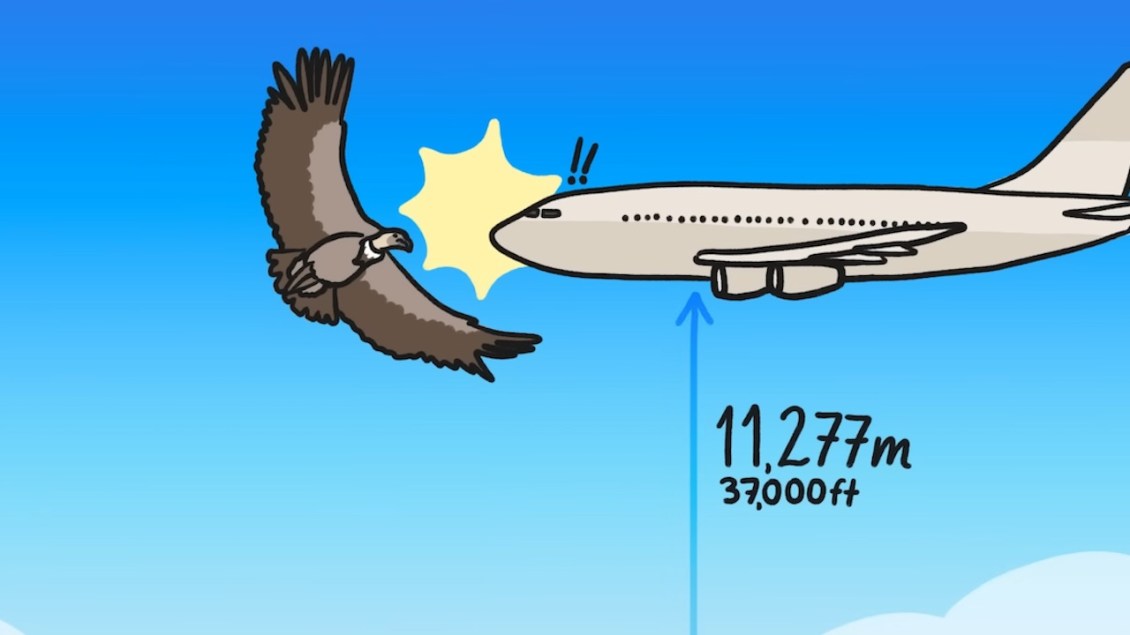
These factors, plus the benefit of thermal columns, make the Rüppell’s griffon vulture the world’s highest flying bird
A bird we know for a fact can fly higher than 11,000 m. Our math suggests that it is lift-limited a lot lower than that, about 8,200 m. But this is where theoretical calculations fall short without some additional real-world knowledge. See, the Ruples Griffin like to soar on thermals, warm columns of rising air that can help birds exceed their mathematical lift limit, sometimes even thousands of extra meters up into the air.