

guest post by Burstein!
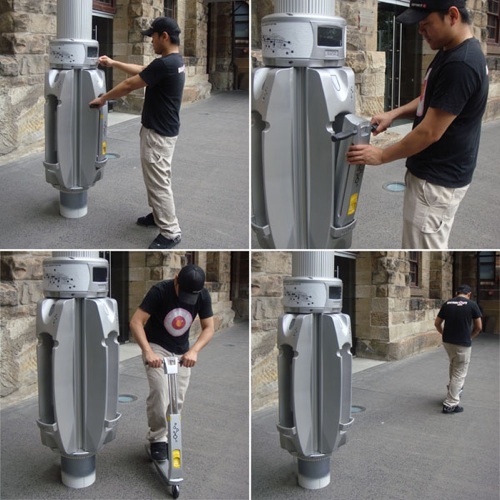
The Australian Design Awards has some beautiful entries, but the Student section has a real winner that proposed a aesthetically pleasing solution for cheap urban transit that allows individuals greater control over their destination than static routes like MUNI or BART. Mr Anton Grimes makes an interesting environmentally based pitch for his design:
With increasing demand on an already over-stretched transport infrastructure it makes sense to shift the way that we move, by taking up less space per individual while in transit. The energy required to move the individual is also greatly reduced by reducing the size and weight of the vehicle. The device also removes direct emissions away from the city and with the addition of environmentally sustainable power generation off-site, the device has the potential to have no net emissions. The product uses primarily Aluminum in both the scooter and the hub. While being more energy intensive than several other possible materials, it provides the most appropriate weight and strength properties to make the parts withstand day to day use or neglect on the street. The parts can be cleanly mechanically separated in order to recover the material for re-use.
Personally, I will gladly welcome our Scootery masters so long as it means never having to see this again.
via Treehugger